Stop giving your B2B AI a pet name
Every SaaS company seems to be going through the same ritual right now. Ship a handful of AI features, gather them into a suite, and give that suite a name that sounds like a scented candle or a golden retriever.
I have a strong opinion on this, and I've been sitting on it for a while: B2B (business-to-business) products shouldn't give their AI a branded name. Not the agent, not the suite, not the sparkly badge in the corner of the UI.
B2C (business-to-consumer) products? That's a different story. I think Instacart's Clementine and Meta's Muse are genuinely great names, and I'll explain why I don't think that makes me a hypocrite. But first, some context on how I ended up defending this hill.
A product marketing title I didn't see coming
Officially, I'm a Product Marketing Manager at Customer.io. If you've read my writing before, you know my background is in lifecycle and email marketing. The product marketing title more or less fell into my lap when I joined in 2022. I hadn't done product marketing before, but I felt capable enough to take it on, and I was excited for the opportunity.
Four years in, it's been a real joy and a real challenge. The core of the job is shaping the outbound presence of the features a business launches. Then there are the other hats: sales enablement, internal training, and a few smaller hats I wish I could wear more often. Helping shape the roadmap. Collecting customer feedback. Talking with customers about their experience.
When Customer.io started exploring AI offerings in early 2025, I jumped in to help mould how we'd market them externally. One of my very first strong opinions was that we should not brand our AI features as a named suite.
Everyone else was naming theirs
At the time, the customer engagement space was split.
HubSpot had gone all in. At INBOUND in September 2024, it launched Breeze, bundling a copilot, four AI agents, and 80+ embedded features under one brand name.
Braze had gone the other way. In June 2023, it collected its AI capabilities under the name Sage AI by Braze. By early 2025, Sage was out and the suite was simply BrazeAI. Braze even updated its original Sage announcement post to read BrazeAI.
Intercom had Fin, the AI customer service agent it introduced in 2023.
My gut said: don't do this. It's a bad idea. If we're moving toward a world where everything includes AI, why would we carve out an AI product with a toy name?
Why a cute AI name works against B2B
One person's clever name is another person's dog
A toy name for your AI cheapens your product. What sounds clever in a naming workshop can land as childish with a buyer. It could be the name of someone's dog. It could be the name of someone's great-grandfather. It could be a made-up word that, it turns out, is also a bird found only on the northwest coast of Portugal.
You don't control the associations people bring to a name. And in B2B, where someone usually has to justify the purchase to their boss, playful can quickly read as unserious.
The runway is shorter than you think
If AI is going to be embedded into every corner of your core product (and it is), a branded AI suite has a short shelf life. You end up with two names competing for attention: your core product name and the AI name you just launched.
HubSpot shows how fast that gets messy. Within two years of launching Breeze, the brand has been taken apart piece by piece:
Breeze Intelligence was retired in June 2025, with its features moved under Smart CRM.
Breeze Copilot became Breeze Assistant.
Breeze Agents became Agent Hub when it launched in public beta in July 2026, and Breeze Studio became Agent Builder.
That's a lot of renaming for customers, partners, help docs, and onboarding flows to keep up with. As a Lifecycle Marketer, I think about every one of those names showing up in a welcome series, a release note, or an in-app message that now needs rewriting.
When the AI name wins, you still have two names
Intercom is the exception that proves the rule. In May 2026, it renamed the entire company to Fin. CEO Eoghan McCabe explained that they'd been promoting Fin for years with Intercom mostly in the background. Funny enough, the AI name ended up eating the company name.
But even then, the help desk product kept the Intercom name. Customers now buy Intercom from a company called Fin, which Salesforce finished acquiring in September 2026. It worked for them because they went all in on a single AI product. Most B2B companies aren't willing to rename themselves after a feature, and they shouldn't have to.
Everyone else ends up toggling between two names in every piece of marketing material. I'm not saying people can't keep up. They absolutely can. There's just no reason to make it this messy.
Every mention should point home
The less marketing debt, the better. Name projects internally all you want, but your external presence should focus on your core business name. That way, every time you're talked about, there's a consistent line back to your business.
When someone advocates on your behalf, talks about your brand on a podcast, or recommends you to a friend, you lose affinity every time you introduce another product name. Each time a business starts yelling a different name at its customers instead of the name (or domain) it ultimately wants to be recognized by, it's spending brand equity on something it doesn't own long term.
The line that bought me time
Honesty moment: in the early debates, my best weapon wasn't any of the arguments above. It was this one: "I don't think we should launch a branded name until our AI features are considered complete."
That line has no end date. AI keeps accelerating, and nobody knows when it'll slow down, let alone reach feature complete. But it calmed the conversation long enough for me to workshop the real arguments.
So why do I love Clementine and Muse?
Here's where you could call me a hypocrite. Two of my favourite launches this fall are named AI products.
Clementine gets a name because it gets a personality
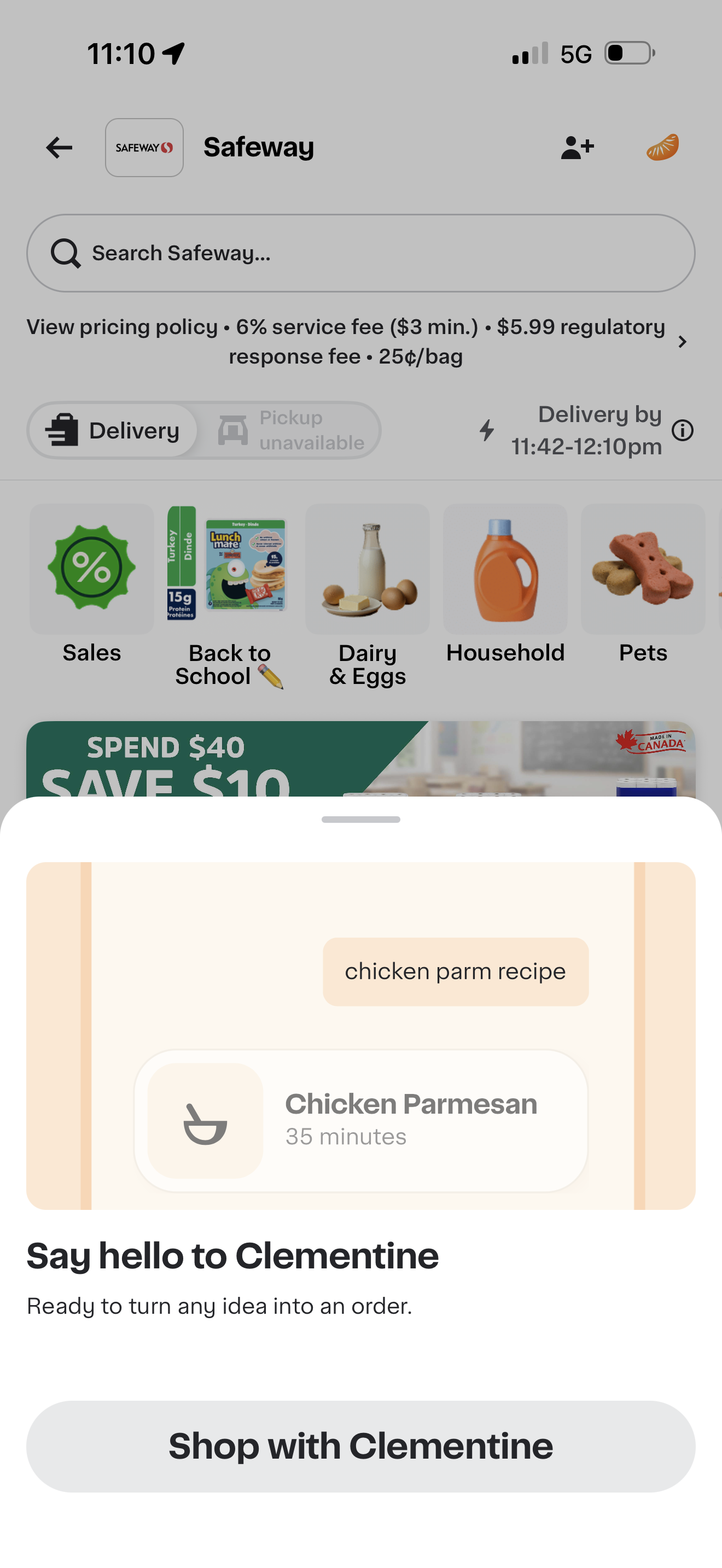
On September 9, Instacart launched Clementine, an AI shopping assistant that turns a conversation, grocery list, or recipe into a ready-to-buy cart. It's available in the US and Canada. I think the name is genius. It's memorable, warm, a little bit edible, and easy to talk to.
Here's the detail that seals it for me. Instacart also sells a white-label version of the same technology to grocers, and that B2B product is called Cart Assistant. Retailers can even customize the assistant's name and tone. Instacart gave the consumer assistant a personality and the business product a description. That's exactly the split I'd make.
Muse gets a name because it's a separate product
On September 8, Meta launched Muse, a personal AI agent with its own app, its own website, and access through WhatsApp.
When I think of Meta, sure, I think of Facebook. But I also think of Instagram and WhatsApp. Those are all distinct products with distinct experiences, and Muse fits in that same vein. It isn't an AI layer sprinkled across Facebook. It's its own thing, so naming and marketing it like its own thing makes sense. And like Clementine, Muse is a fitting name.
Where I draw the line
So my rule isn't "never name your AI." It's this:
A consumer experience people talk to like a person can earn a name, because the name builds affinity.
A standalone product with its own app, audience, and experience can earn a brand, like any other product.
AI woven into your existing B2B platform is your product. Call it your product.
Keep the fun names internal
To be clear, I love internal project names. A good codename brings colleagues together around a common goal. It adds creativity, and it keeps Slack channels and internal discussions clean. Name away.
The challenge for Product Marketers is reminding our colleagues (engineers, product managers, leadership) why that name stays internal. What we've built needs to fit into our existing brand story, or strengthen it, so every win ties back to the core business name instead of a side brand.
If you're in the naming meeting
Whether you're a Lifecycle Marketer, an Email Marketer, or a Product Marketer, you'll probably end up in this conversation at some point. A few things I'd bring with me:
Ask the two-year question. What happens to this name when every feature has AI in it?
Describe it, don't christen it. Users care what a feature does, not what we hope it represents.
Run the referral test. When a happy customer recommends you, which name do you want them to say?
Count the touchpoints. Every new name has to be explained in onboarding emails, in-app messages, help docs, and sales decks. That's real work, forever.
Offer the codename as a win. Engineers and PMs can keep the fun name internally. Nobody has to lose the naming battle entirely.
Clarity over cleverness
If your AI is part of your product, let it make your product better, and let your brand take the credit. Save the names for the products that truly stand on their own.