The largest launch I’ve ever done in the smallest time frame possible
Earlier this year, I led the largest collective launch Customer.io has ever done. Just under 10 features, across at least five squads, with a runway of less than 30 days. It's a launch I think I'll look back on for the rest of my career, partly because it went well, and partly because of how much I learned pulling it off.
I've written before about how I approach go-to-market and my shift into product marketing. This post is more of a behind-the-scenes look at one launch in particular: how it started, the stakeholders I needed in my corner, how we decided what to focus on, the collateral we built, and what I'd change next time. If you're a Product Marketer or a Product Manager, I hope there's something in here you can take back to your own team. And if you're a Lifecycle Marketer, there's plenty in here about the emails, in-app messages, and automations that went along with it.
I get in the room the day it opens
I've had a lot of conversations internally about how marketers stay in the loop, so that we're not the last people to know something is shipping. I've also had the flip side of that conversation: how do we take the burden off of Product Managers having to remember to loop us in at every stage?
My solution is pretty simple. I have Slack alerts set up for whenever a new channel is created.
At Customer.io, engineers and Product Managers usually spin up a project channel for each feature they're building, and I can often tell right off the bat whether that feature will eventually need to be marketed. If it will, I join. I'm not there to slow anyone down. I'm there so I'm in the room when decisions are being made, instead of finding out a week before launch.
For context, I'm the Product Marketer for anything AI that spans the entire product (like our AI Agent), and I'm also assigned to the content squad. In early March I was in about five project channels, and it was becoming pretty clear we were heading into a big quarter.
The perfect storm
Leadership at Customer.io is highly encouraging of shipping fast. Rather than running long alpha programs where feedback sits around waiting for a go-ahead, the goal is to get a good product into the hands of marketers as soon as possible, then learn and iterate from there.
At the same time, a handful of big features were all taking shape:
Our AI Agent, which can build campaigns and segments from a plain-language prompt, because it actually understands your workspace
LLM Actions, which let you call out to an LLM in the middle of an automation (for example, to enrich a contact's profile)
Goals, which tie every campaign and broadcast back to the metric you're actually trying to move
An expanded MCP server, so you can create and edit campaigns from tools like Claude
Universal Search, which lets you pull up a search bar, type something like "win back," and see every segment and automation that matches. I'm a huge fan. It gets me into the product so much faster than clicking through tabs.
WhatsApp and LINE as two new channels
A UI refresh, plus a new performance dashboard and a handful of smaller features
As I was lurking in (and helping shape) all of these channels, there was always one question in the back of my mind: what does marketing this look like? I don't consider a feature shipped until it's marketed. Sometimes that means a one-off push, and sometimes it means bundling. In this case, there was a really clear story to tell if we launched the AI Agent, the MCP server, Universal Search, and the UI refresh together.
Funny enough, the idea didn't come from me. In the UI refresh channel, one of our engineers, Kevin, asked whether we should ship the refresh alongside everything else, since the AI Agent and Universal Search were already introducing new UI elements.
I immediately raised my hand. I've been the user who logs into a tool one morning to find everything has moved, with no story about what changed or why. It interrupts your workflow, and it's frustrating. If we were going to put this many new things in front of people at once, we owed them a story.
So I created a Slack channel called 2026 April Mega GTM and brought in every tech lead, engineer, and Product Manager involved, plus a few marketing leaders. My pitch was simple: Kevin suggested we ship these together, so let's market them together, with one big story about why these features matter, why now, and how they'll help.
Getting the green light from engineering
The first hurdle was getting the people actually building these features to agree they'd be ready by a specific date.
This is the greatest struggle I have as a marketer. We want a committed date so we can create real buzz. Engineers and technical folks often can't commit, because bugs happen and scope changes. And honestly, I see both sides. When I put on my product hat, I'm thinking: don't commit to a date. What if we need to build more? What if we hit bugs? Committing too early is how you end up shipping an incomplete, frustrating experience, and as someone who uses tools like ours every day, I would always rather a product ship when it's actually ready.
But as a marketer, if I know something is going to be ready (or it's ready early and can sit behind a toggle for a week so we can tell a coordinated story), I'm going to push for that.
The struggle? Getting both sides to agree that coordinating is worth it. The solution? In this case, I didn't have to fight for it. I had people in my corner on both the product and marketing side who agreed a coordinated launch was a good idea. Thank goodness.
Picking a date (and throwing spaghetti at the wall)
I like working at fast-moving companies because things ship quickly, and I'm not waiting months for collateral or buy-in. I like the adrenaline. I'd rather be a little stressed for a day or two than bored for three months.
Even so, when one of our senior technology leaders wanted to launch the headline feature two weeks after the channel was created, I had to pump the brakes. Looking at the next 30 days, I saw two problems:
Easter. A long weekend is a bad time to launch anything. People are offline, not reading emails or marketing content.
April Fools. It's become a day for joke launches (mail via carrier pigeon, that kind of thing). Real announcements get lost in the noise.
So I threw some spaghetti at the wall: April 8. That was about a month from the day the channel was created, with time for people to come back from Easter and for the April Fools dust to settle. Incredibly tight for nearly 10 features, but I thought we could pull it off.
Yes, I was annoying
I posted in the channel: I want to launch on April 8. Can you please commit your feature, or tell me your hesitations about why that date won't work?
To be fully transparent, that thread had at least 50 replies, many of them me tagging the same person a second or third time. Like anyone, I have a fear of being annoying. But at the end of the day, I don't really mind. A few people might remember me as annoying. More people will remember that we pulled off a huge launch.
Some marketers would start with the story. I don't build a story until I have commitment that a product is actually shipping. Once I have that commitment (light or heavy), I can move fast on how we'll tell the story and how we'll deliver it.
Async over meetings
I much prefer async communication to meetings. Meetings sometimes feel like a slap on the wrist to me, and at a global company like Customer.io, finding a time block that works for everyone is hard.
I believe you should be able to get commitment on launch dates and scope async. If people can't agree there, then you bring them into a room to talk through why the date won't work.
Slack also creates a really good paper trail. If someone says "I never agreed to that date," I can point to the thread where they did. And I want people to feel confident sharing their reasoning in public. Communicate effectively and succinctly, and tell me why your feature can or can't make it.
Why I don't love the title "marketer"
A quick tangent, because I think it's a big part of why this launch worked.
I don't love that my title has "marketer" in it. Marketing sometimes gets a bad rap. We're seen as annoying, or slow, or the team that describes a feature in a way that isn't quite what it does.
Since joining Customer.io, I've tried really hard to embed myself with the product and engineering teams. I want to work in lockstep with them. I don't want to be an extra limb they have to remember to move when they launch something. I want to be in the early conversations, help shape the product, and help deliver user feedback.
If you're reading this and thinking "that sounds like a Product Manager," or "in my company, product marketing sits under product," you're not wrong. I don't know that there's a right answer for what my title should be or where I should sit in an organization. Wherever I work, I'd work this way.
It's also why I join our hack weeks, even though they're mostly geared toward product and engineering. I don't have a huge technical skill set, but one of my projects has won an award of some kind for the past few years, because I can tell a story about it and paint the picture really well.
The long and short of it: internal relationships are a big reason I'm successful in my job. Whether it's a small launch, a hack week project, or the largest launch in Customer.io's history, I really enjoy collaborating with the people who build the product. Half the fun is that I'm an end user of it, and I'm genuinely curious about the roadmap.
My go-to-market template (and where Claude comes in)
With initial commitment on the core features, I started on go-to-market.
I use a GTM template I built in Notion. I fill in the baseline context myself:
The Slack channel
The Linear project
Who's leading the work
Why we're building it
Who the end user is
From there, Claude fills out the rest for a first draft. It connects to Linear (where our engineers and technical leaders organize their work) and Slack to pull project context, plus whatever extra notes I give it. The template covers positioning (pain points, value pillars, and an elevator pitch), internal enablement (a sales talk track and an internal release post), a competitive analysis, external copy for in-app, release notes, email, newsletter, and LinkedIn, and FAQs.
With that, I can generate a first pass of a dedicated email, an in-app message, a blog post, paid ads, and LinkedIn copy employees can share with their own networks, give it my own edit, and have it ready for leadership in about 20 minutes.
That 20 minutes doesn't include the time it takes to figure out the story itself, and how I want our audience to receive it. That can be anywhere from 20 minutes to multiple hours. I'd been thinking about this story since early March, so the first pass came together quickly. The review and feedback rounds took longer, as expected.
I don't tier my launches
I've done plenty of individual launches, and I've never formally tiered them. Tiering doesn't feel very intuitive to me, and every company has its own definition of tier 1, 2, and 3. I prefer more human terms: this is a huge launch, this is a pretty big launch that will impact a medium percentage of our users, or this is a tiny launch only a small percent of users will notice.
In formal terms, this was a tier 1 launch. In elementary terms, it was the largest launch we'd ever done in the smallest time frame possible. We'd never done a coordinated launch of multiple features on the same day, and many of these AI features hadn't been out in alpha or beta.
That's how I pitched it internally: you want to be in the room for this one, or you'll be sad you weren't. Somehow, that worked. A few technical leaders raised their hands with smaller features they wanted to add.
We set a cutoff two weeks before launch, with a core set of five features committed. The core five needed that lead time for video content and website design. Smaller features were much easier to add after that, since they only needed a mention in an email or in-app message.
Yes, we really called it "This changes everything"
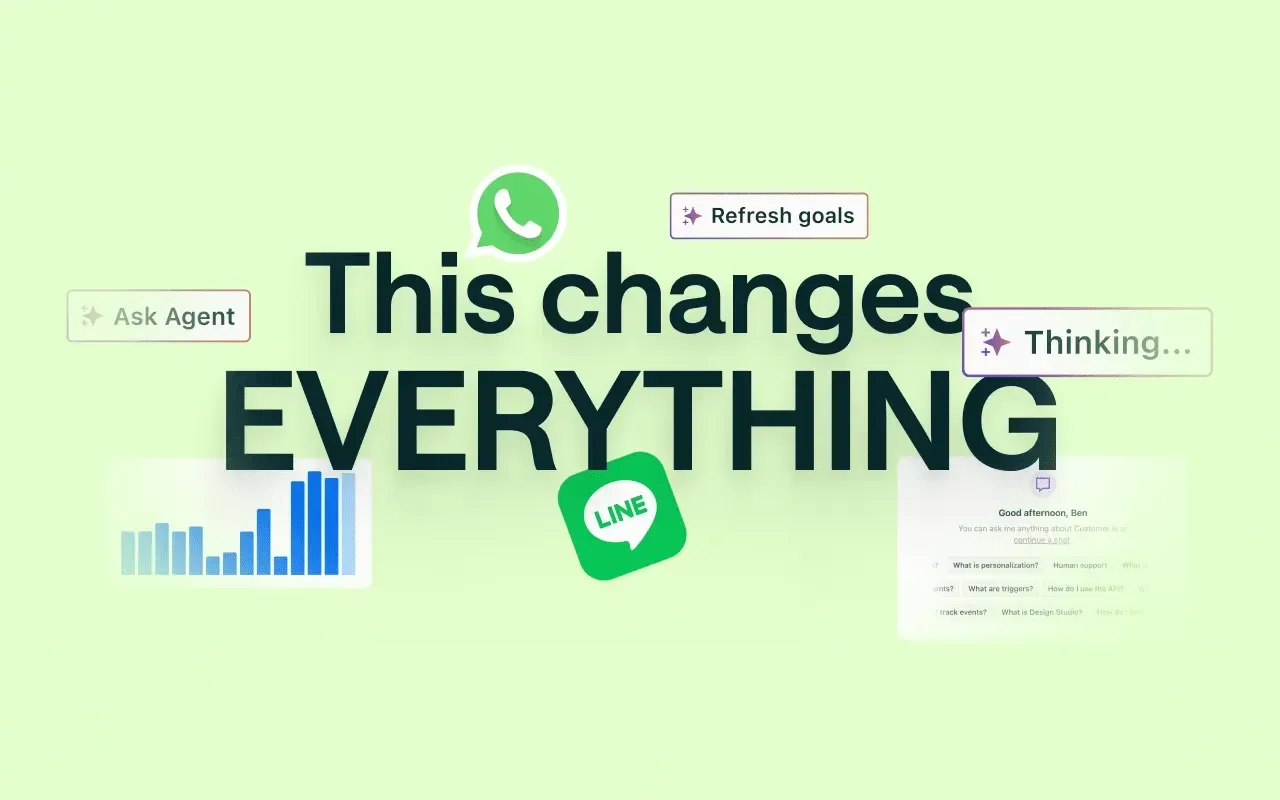
"This changes everything" is a headline we see all the time in tech marketing, and nobody ever stops to point out how ridiculous it is. Does a SaaS product launching a new feature really change everything? (No. Your inbox, your coffee, and your Monday morning stand-up are all exactly the same.)
So I leaned into it. We named our launch webinar This changes everything, a little wink at one of the most overused lines in SaaS. It's self-aware, it's a bit cheeky, and it gave us permission to have some fun with a launch that was, to be fair, the biggest in Customer.io's history.
The launch blog post came at it from the other direction. Instead of claiming the release changed everything, the headline read: "Some launches add features. This one adds up to something." That was the real story. No single feature changed everything on its own. Together, the AI Agent, LLM Actions, Goals, Universal Search, WhatsApp and LINE, and the redesigned UI added up to a genuinely different way of working in the product.
If you're writing launch copy, my take is this: go ahead and use the cliché, as long as you're in on the joke. Just don't expect the cliché to do the work for you. The features (and the story that ties them together) still have to.
A webinar with a one-week runway
I love hosting events. I created Unpacked, Customer.io's virtual conference, and we've run it every year since 2023. It's been my pride and joy. So for our largest launch ever, I really wanted a product webinar to go with it.
If you get a launch email about a new feature and you're not sure how you'd use it, a webinar can unlock a lot of ideas and inspiration quickly. It's also a great way to engage agency and technology partners, so they feel ready to bring these use cases to their own clients.
We held the webinar on April 16, about a week after launch. That caused some internal stress ("Should we give them more time?"). My answer was no. There's a lot of fatigue around online events you sign up for three weeks in advance. The day rolls around, and you decide to keep your head down and do your regular job instead. A shorter lead-up catches people while the announcement is fresh, and they want to learn about the feature as close to launch as possible.
That theory held up. It was the largest live attendance we've had for any online event or webinar.
Here's how it came together:
A dedicated landing page that fed registrations into our webinar platform.
One webinar, different invites. There was one time slot (plus a recording), but each audience got its own message. I sent dedicated emails to customers, worked with Demand Gen to bring leads back into the fold, and worked with our partners team on how we invited partners. We also promoted it on LinkedIn.
Live demos instead of slides. I worked closely with our Product Managers on what they'd show. Instead of a slide that says "this can increase your open rates by 40%" (such a fatigued story), they walked through a real example in the product. Attendees could put themselves in that PM's shoes, then take the exact example back to their team or test it in their own account.
I especially love a demo for leads. Instead of the slides an account executive might show on a call, they see the product with real data, numbers, and responses. They get a sense of what it'd be like to be a paying customer.
Launch day: a war room without the room
A launch this size still needs a war room. Someone has to coordinate who ships what, and when. I've just never loved the term. It's a pretty intense name for what's usually an hour-long Zoom call or a Slack channel.
I'm on the West Coast, so I needed things to start going live in the early morning, but not dark-out, haven't-had-my-coffee early. More like 7 or 8 a.m., when I could be at my computer tagging people, so content hit Europe at the end of their day, the East Coast in the late morning, and the West Coast as people logged on.
Everything ran out of the same Slack channel we'd been using since March, in three phases.
Phase 1: Ship the product. I tagged about five people, on a coordinated schedule, to push their features live. Most of our engineers and Product Managers are on the East Coast, so their coffee had already kicked in. It was a matter of shipping a couple of PRs or flipping a few toggles. In one sweeping motion, we had a live AI Agent, LLM Actions in our automations, Goals, a new UI, and Universal Search.
Phase 2: Website and docs. Next came our homepage and a few dedicated landing pages with the new narrative. I also tagged in our documentation team (two really fantastic people) to confirm the docs for each feature were live. In hindsight, I'm not sure the website needed to be a hard requirement before phase 3, but since we were sending people to those pages, it was probably still the right call.
Phase 3: Tell the story. This is what users actually see. Social posts on Instagram, Twitter, and LinkedIn. Dedicated emails. A multi-step in-app message that worked like a carousel, so people could swipe through each feature.
People replied with an emoji or dropped a comment in a thread when their task was done, then carried on with their day. I closed out each phase with a big all-caps message, like "PHASE 2 COMPLETED, MOVING ON TO PHASE 3," so anyone scrolling past knew exactly where we were.
Our CMO was very much aware of what was happening that morning, and was probably watching the channel more closely than I was, hoping no message would come through saying something had gone awry. None of us needed to sit in a Zoom room to make that happen.
That's thanks to strong relationships, trust, and a launch plan that was clearly shared ahead of time. I shared the detailed plan a week out on purpose. People are working on so many things, and information delivered close to when it's needed stays top of mind. Not knowing the exact plan two or three weeks out is fine. That's my job to worry about, not theirs.
I'm also someone who overcommunicates, or at least tries to. Over the past four years, that's gone from writing novels to writing short sentences that put the important information first. For this launch, it looked like quick reminders of what was happening and where to find information, with the go-to-market plan as the single source of truth for every feature.
The product beat us to it
One thing I didn't expect: people noticed the product changes before our marketing reached them. The UI overhaul is what caught people's attention first, and the marketing that followed pointed them toward the new features that came with it.
A good reminder that the in-product experience is part of your launch too, and sometimes it's the loudest part.
A little whimsy
I'm not a very serious person. I hate red tape and bureaucratic processes. I like to move fast and have fun with what I do. I'm not saving lives, and I work on a product I actually really like.
So when an engineer has a fun idea that helps me tell a better story, I love my job 10 times more than I already do. For this launch, one of our lead engineers built a retro, arcade-style video game themed around email. It kept score, and you could see your colleagues' scores right inside Customer.io.
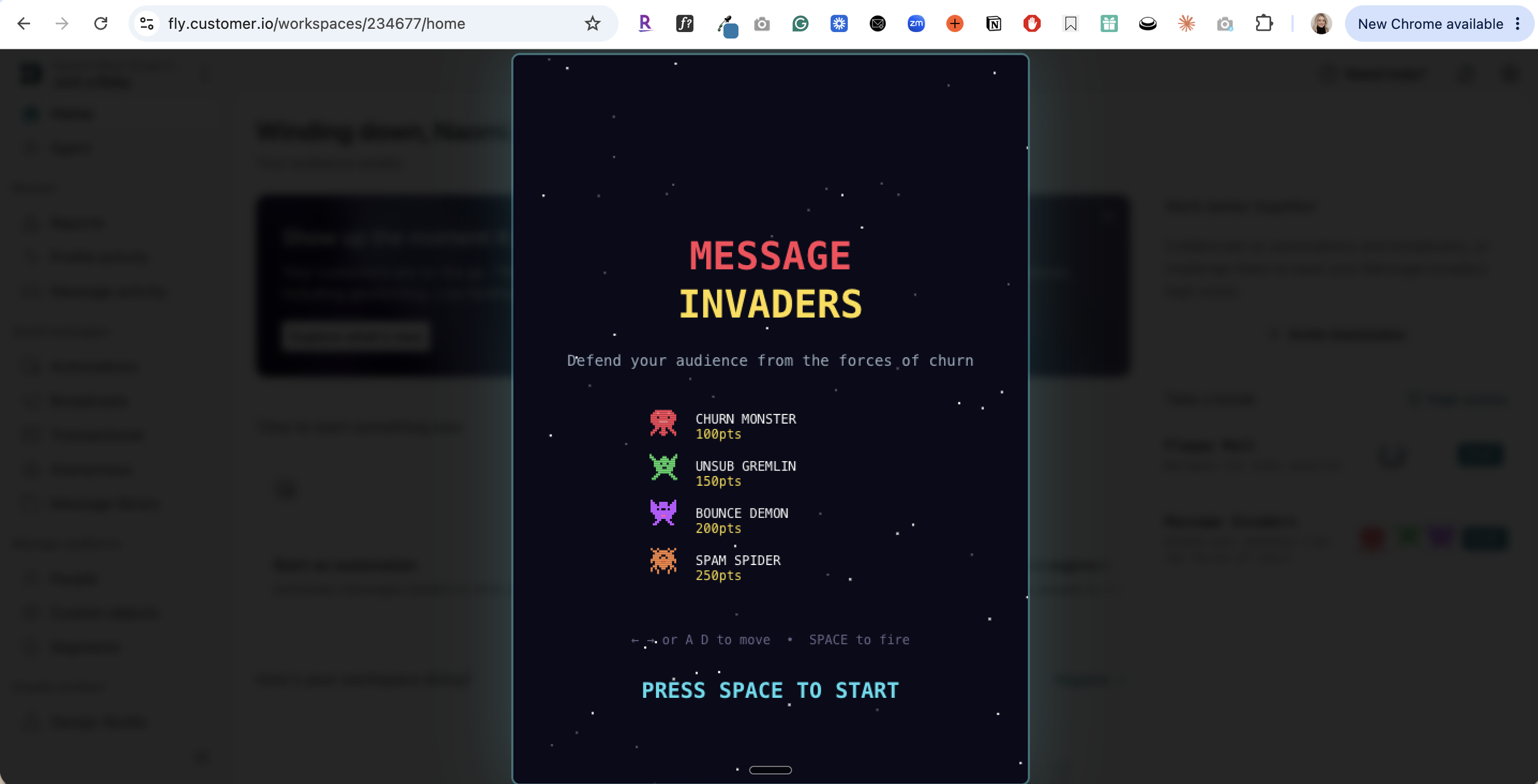
It was a little Easter egg, but it let us show that we deliver valuable features and a bit of whimsy too. You can actually enjoy the product you use at work.
Feedback loops, built in
After launch, we saw engagement spike across the features we launched. A good handful launched into beta, so this was the first time we were putting them in front of users.
To make the most of that, I set up automations with our Product Managers. When a user hit a certain threshold in the product, they'd get an automated email from the PM asking for feedback and offering to set up a call.
These are super easy to set up alongside a launch, and that early, proactive outreach before you GA a feature makes the next iteration of your product so much better.
What I'd do differently
This launch was really fun to work on. It was also stressful in the moment, and some of that stress came from the amount of extra lift involved.
Have a demo brand ready before you need it
For the webinar, we wanted a workspace with real-looking data and no PII. So a week or two before, I created an entirely fake business called Lenora.io: a fictional AI company that became the centrepiece for every webinar example and every screenshot on our website.
Lenora.io needed its own brand and voice, so one of our designers was looped in to create a full brand identity, on top of all the launch collateral and website updates he was already working on. Then I had to learn how to push dummy data into the workspace. We had internal mechanisms for it, but there was a learning curve, and I stayed online until 9 p.m. on a Friday figuring it out.
The silver lining: we've used Lenora.io in every launch since. But next time, I'd build it before I needed it.
Video needs an owner (and more time)
Video production was the biggest area we needed to improve. At the time, we didn't have anyone in-house for video, so we worked with an outside agency on storyboarding, soundtrack, voiceover, and visuals, all in a very short window.
I used tools like Screen Studio and Loom to record clips, then passed them to one of our designers, who coordinated with the agency. Recording polished 2 to 3 second clips of features while they were still being built was incredibly difficult, and we spent lots and lots of time re-recording. I don't identify as a motion designer. We really needed an extra week or two once the features were stable enough to record, and someone internal to own video while I project-managed everything else. I can't be everywhere at once.
Please, post it in the channel
My biggest learning was about DMs. I really struggle with DMs in Slack when they're about a project. If someone DMs me a launch question, I can almost guarantee someone else in the channel has the same question. Now I'm answering it in multiple places. At one point that channel had over 100 people in it, and the time I spent answering individual DMs added up fast.
There's another reason too. When I ask Claude, "What are the latest updates in this channel? Are there any unanswered questions?" it pulls from the whole channel, not from my one-on-one conversations.
So I kept encouraging the group: if you have a question, post it in the channel. Don't stress about it being a dumb question. No question about a launch is a stupid question, unless it's sent by DM. No one is going to remember the one thing you posted in Slack a week from now. No one. And others will probably benefit from it.
There's a time and place for DMs. If we're working one-to-one on something, or we just got off a Zoom call and want to keep chatting, great. But if your question is:
What features are launching with this go-to-market?
Where's the sales enablement collateral?
What date is the webinar?
How do people sign up for the webinar?
Don't come to me directly. Go to the channel. Those questions will come up again and again, so I also set up auto-responses in the channel to answer them, which saved me a lot of time.
Launch when there's a story, not because it's a new quarter
I don't think this launch can be replicated exactly once a quarter. It worked because the features being built at that moment told a story easily when launched together. It was the perfect storm, and I love a storm. (I'm a big tornado watcher, so I enjoy this kind of adrenaline.)
If you're planning a quarterly launch, I'd ask:
Are we launching because it's a new quarter and we feel like we have to?
Or do we have a set of features launching around the same time that tell a clear story?
Can I take this pitch to engineering and have them easily agree it's a good idea?
Launches are good for company culture
Something I don't think people talk about enough: companies need launches like this the same way they need hack weeks, company retreats, or revenue kickoffs.
Every company has low moments in a year. People leave, layoffs happen, org changes bring morale down. Launches like this are an opportunity to bring it back up. They get sales hyping up the product in a different way, get marketers spinning their creative wheels, and get engineers and tech leaders excited about what they're shipping.
Yes, they're stressful, because people need to ship faster. But these moments shape company culture in a way that can't be engineered by the people team or a Friday afternoon happy hour. They bring people together, get them thinking critically about the user experience, and leave them feeling proud of what they built.
The short version
If I had to boil this launch down:
Get in the room the day the project channel opens.
Get commitment before you build the story.
Pick a date with the calendar in mind, not just the roadmap.
Keep it async and in the open, so there's a paper trail.
Run launch day in phases, in one channel, with clear tags.
Build feedback loops into the launch itself.
Launch when there's a story to tell, not because a new quarter started.
And please, keep your launch questions out of my DMs.